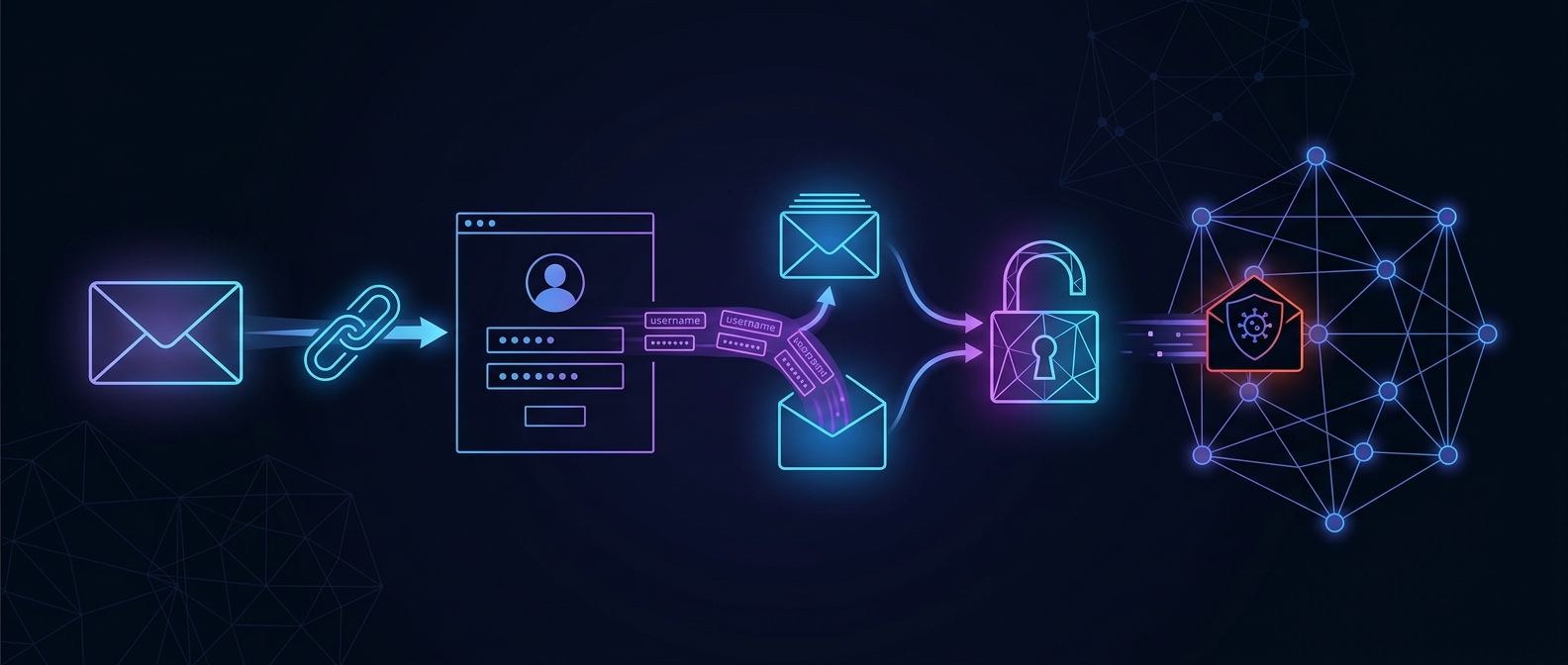
Phishing is still the number one way attackers get in, not because it's sophisticated, but because it targets people, not firewalls. Understanding the chain is the first step to breaking it.
Step 1 — The lure
An email that looks legitimate: a shared document, a password-reset, an invoice, a message from "the CEO." It creates urgency so you act before you think.
Step 2 — The click
The link leads to a fake login page that looks exactly like Google, Microsoft, or your own tools. The employee types their password. The attacker now has valid credentials.
Step 3 — The foothold
With those credentials the attacker logs in, reads email, finds more targets internally, and quietly looks for data worth stealing or a way to escalate access.
Step 4 — The spread
From one inbox, they send more phishing internally (now from a trusted address), reset other accounts, or reach systems that hold customer data.
The controls that break the chain
MFA stops a stolen password from being enough. Security awareness training lowers the click rate. Least-privilege access limits the blast radius. Logging and alerting catch the login that shouldn't have happened.
Why this matters for compliance
Every one of those controls, MFA, training, access reviews, logging, is also exactly what SOC 2 and ISO 27001 ask you to prove. Doing security well and being audit-ready are the same project. Trusto watches these controls continuously so a lapse shows up before an auditor, or an attacker, finds it.